

The advent of smart telescopes has revolutionised astronomy and astrophotography. Even dedicated visual observers are purchasing smart telescopes, owing to their ease of setup along with the stunning images they capture.
Quite simply you attach the smart telescope to a tripod, follow some levelling or alignment routines within the smart scope app, then select your target and start capturing data. For nebula, depending on their magnitude (brightness), you will see results in minutes. Obviously the more data you capture the more defined the image. You can even define a plan so that once setup, the smart scope can be left alone to capture the data and shut down when finished.
As an amateur astronomer with broad interest in the local universe and beyond, I decided it was worth having a go at performing photometry with the DWARF 3 smart scope.
Photometry is the technique where you measure the brightness of light emitted, reflected, transmitted or received from a source by a receiver. With stellar photometry the sources, are typically variable stars and the receiver, in this case was the DWARF 3 smart scope. A variable star is one where its brightness varies with time. There are a huge range of variable stars with periods (time between bright or dim events) from hours to years.
The variable star I chose to test the DWARF 3 telescope on was W Uma which resides in the Ursae Majoris Constellation, and is close to the Plough. The reason for choosing this variable star was because the Plough is circumpolar which means it is always above the horizon in the Northern Hemisphere (although depending on your observing location it can dip behind foreground objects, trees or buildings, at some times). W Uma also has a periodicity of roughly 8 hours, so in a typical single night observation session you can usually see the change.
W Uma consists of a pair of stars with different brightness in a tight circular orbit, with an orbital alignment to the Earth, which means that each star eclipses the other as they orbit each other. The average magnitude (brightness) of the pair is 7.75 mag. This drops to approximately 8.3 mag when the star eclipse each other.
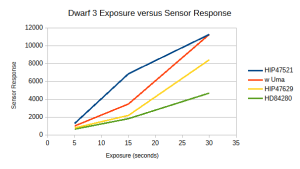
One of the first things it is necessary to do when performing photometry is to work out the exposure time required to capture the stellar image without saturating the stars. The camera will have a defined brightness range from 0 to maximum. The maximum for an 8 bit camera is 255, for the DWARF 3 telephoto camera it is 11270. The plot above shows the response of the DWARF 3 telephoto camera versus exposure time for a number of stars in the region of interest. By 30 seconds exposure the main stars are saturated, but shorter exposures are fine.
A 15 second exposure was used for the actual experiment which provided sufficient image response without saturating (over exposing) the stars. Photometry acquisition was performed over about 5 hours at 15 second intervals. There was a break in acquisition around midnight owing to clouds. The data was processed using the Phoranso software which produces reports in standardised photometry formats. The results are shown in the following plot against Julian Date.
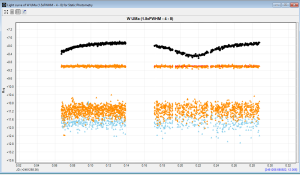
The black markers represent W Uma showing the light curve over time as the two stars orbit each other causing a regular dimming and brightening. The changes observed are an excellent fit for those reported by the American Association of Variable star Observers (AAVSO) https://www.aavso.org/vsots_wuma.
The light blue markers are from the check star, the upper orange markers are the reference star and lower orange markers are the comparison stars. Basically, the reference, check and comparison stars should follow a horizontal line as their brightness should not vary with time. The scatter in the points comes from differences between exposures resulting from changes in sky and seeing conditions, high altitude clouds, etc.
Overall this experiment has proven the usefulness of the Dwarf 3 smart telescope in performing photometry. Not only is the DWARF 3 a fun astrophotography imaging device, but it can also be used for scientific investigations.
Leave A Comment